

Today, the agricultural sector faces a combination of climate risks, price pressure, and financing challenges. At the same time, the State needs greater transparency, control, and planning capacity to respond to these changes. Achieving this requires an integrated and up-to-date view of the national agricultural sector.
Currently, the country does not have a real-time "living screen" of the national agricultural sector. Many producers make decisions without early warnings, while MAG and CENTA operate with scattered data, making it difficult to prioritize actions. Chivo Agro proposes to integrate this information and transform the data into decisions.


Data on soils, climate, markets, and producers already exist — but they live in separate systems and do not turn into decisions. The agricultural sector operates without a unified operational screen. Scattered data leads to late reactions and blind decisions.
The producer acts on intuition, without early warnings. MAG and CENTA prioritize without full visibility. The cabinet lacks a daily overview of "what to do now."

Chivo Agro enhances what already exists — connecting MAG, CENTA, and external sources into a single decision-making circuit.
The data already exists. What is missing is a unified ecosystem that connects it and turns it into decisions. Chivo Agro integrates, analyzes, and delivers concrete actions — from the field to the decision-making room. A system that enables the State to anticipate crises, protect national production, and direct resources where impact is greatest.


Chivo Agro gives the State something that does not exist today: real visibility into the agricultural sector and the ability to act before problems escalate. A unified national overview, transparent budget control, and early warnings that turn data into strategic decisions.
Beyond agricultural management, Chivo Agro lays the foundation for integrating financial tools, blockchain, and traceability — connecting the field with Chivo Wallet, the BCR, and international markets.


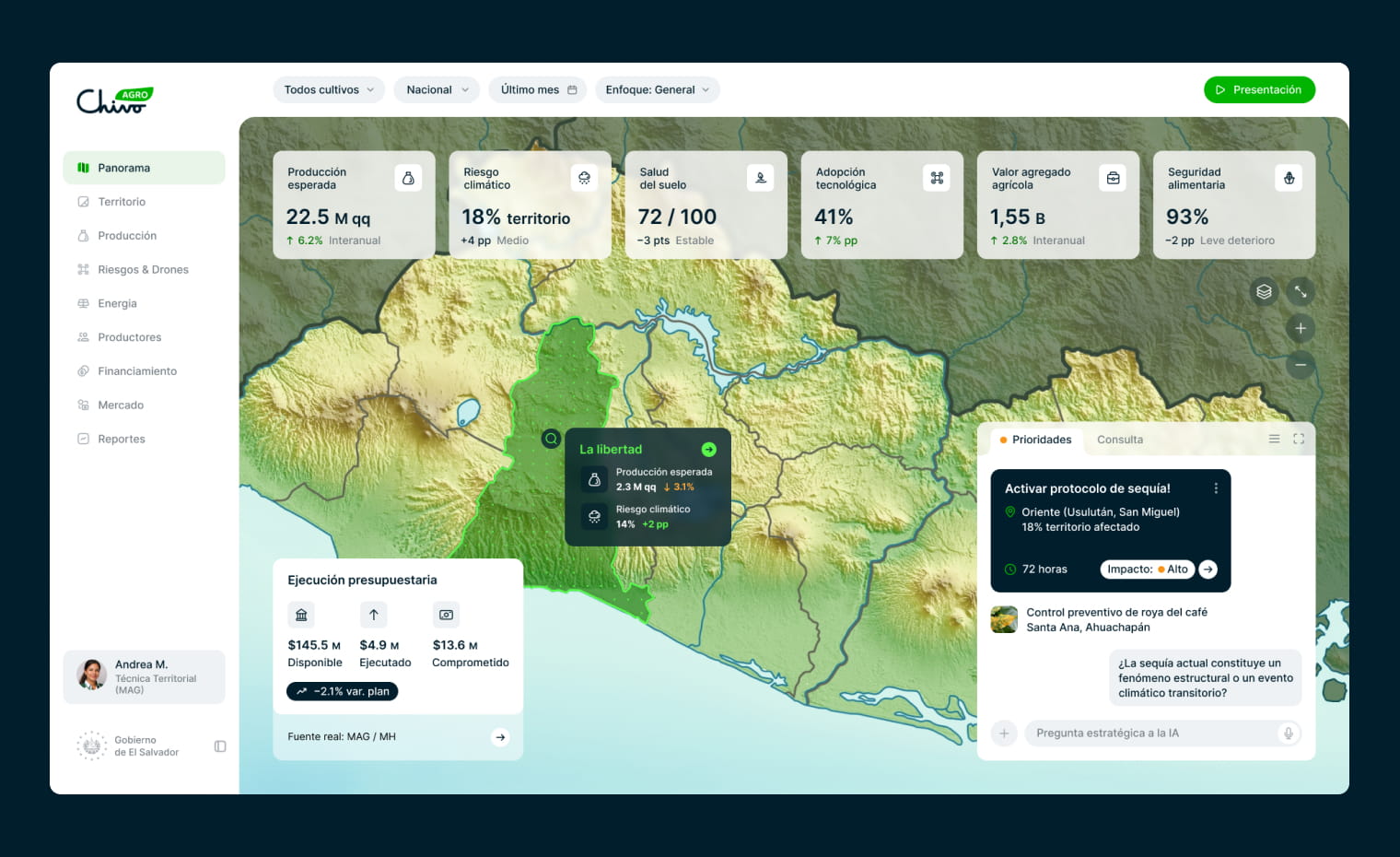
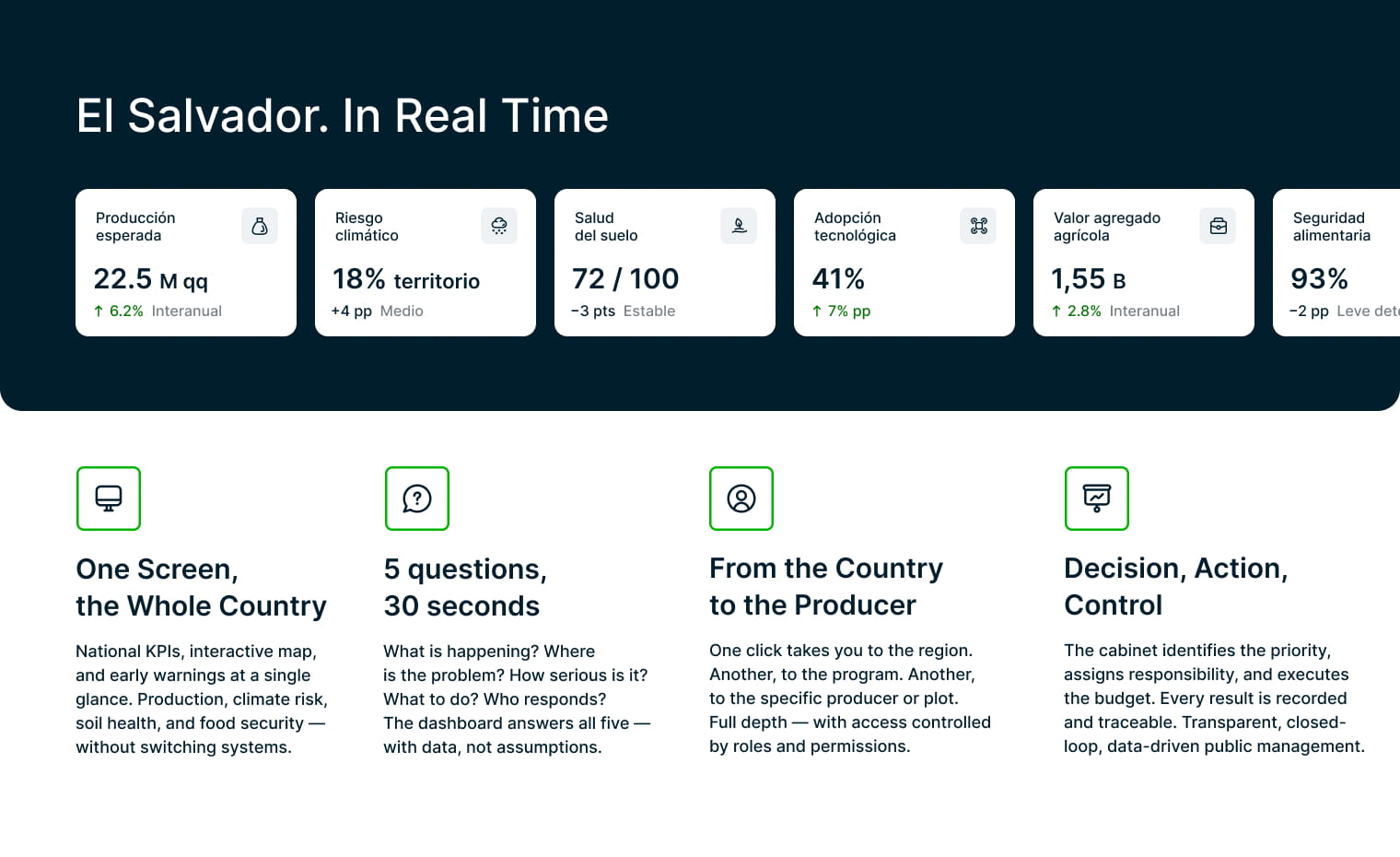
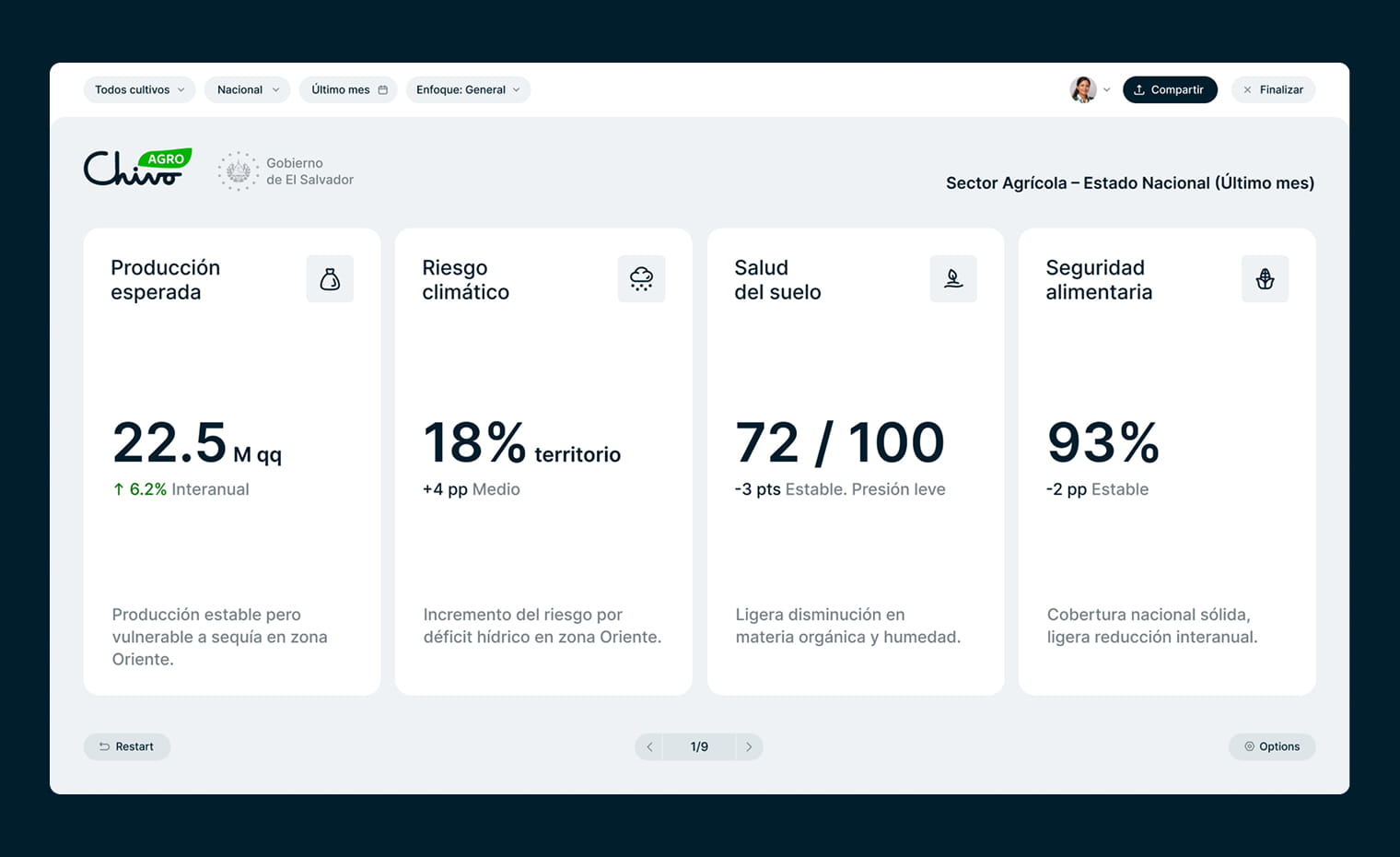
The National Dashboard is the strategic screen of Salvadoran agriculture. Production, climate risks, soil health, digitization, and food security — all in one place, in real time. A tool designed for those who make decisions that affect the entire country.
From the Ministry of Agriculture to the presidential cabinet, each user sees what they need to see. Without unnecessary clicks — the national situation is clear immediately. With one click — it is possible to drill down to the region, the program, or the specific producer.




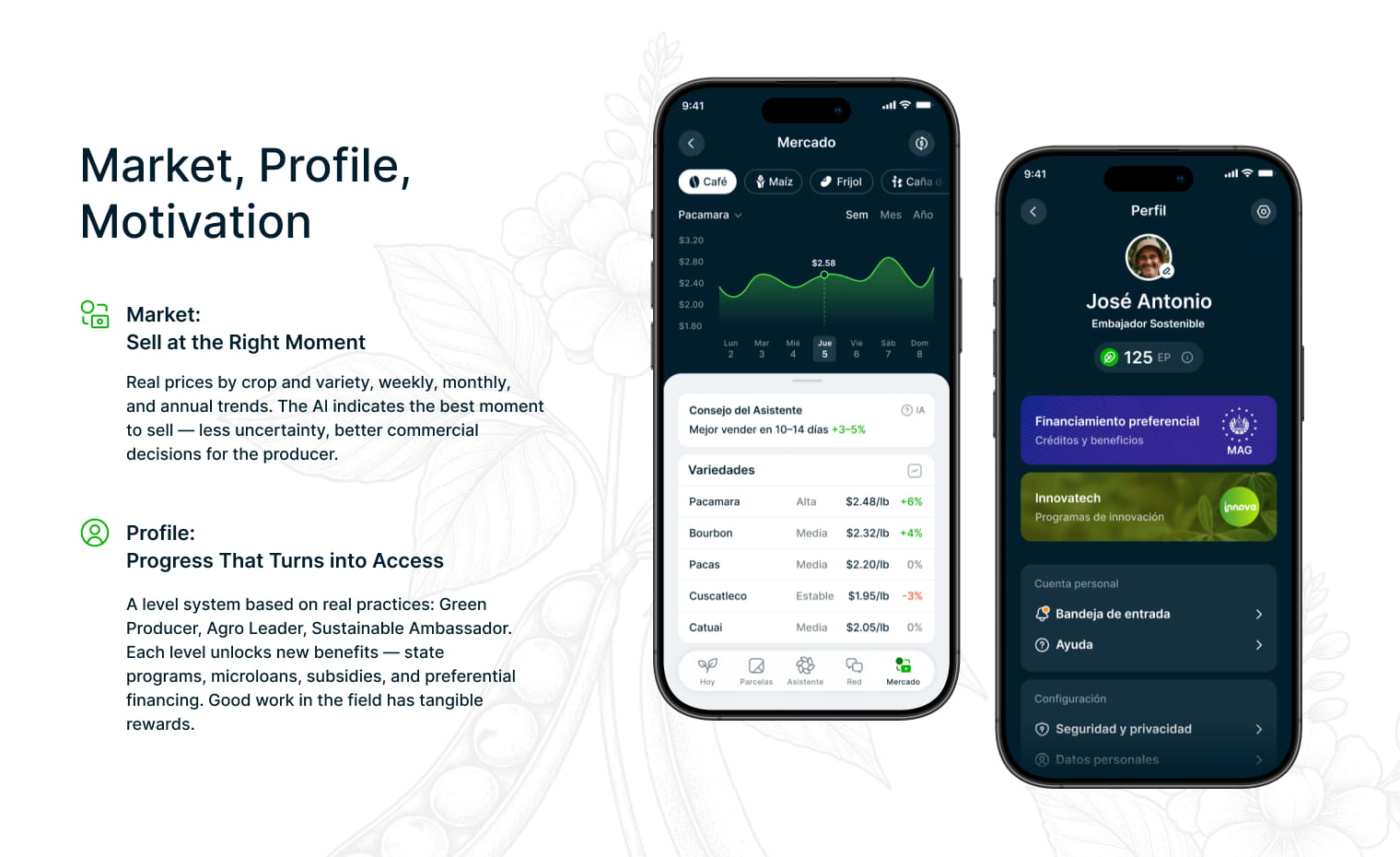
The Producers App turns data on soil, climate, risks, and market into concrete actions for every day. No complex reports, no technical analysis — the producer knows exactly what to do today to protect their harvest and maximize their yield.
Designed for the field: it works on smartphone, tablet, and computer. For individual producers, cooperatives, coffee and cacao exporters, agronomists, and consultants — a single tool that adapts to every production unit.


The agricultural sector represents between 5 and 6% of El Salvador's GDP and is the main source of employment in rural areas. Today it operates with avoidable losses, misdirected subsidies, and late reactions to climate crises. Chivo Agro transforms that reality — with data, intelligence, and decisions in real time.
In a 3-to-5-year pilot, the system can generate an estimated annual economic impact through greater productivity, reduced losses, and optimization of public agricultural spending. All projections are presented as pilot estimates — measurable, transparent, and adjustable with real data from the territory.


Chivo Agro proposes a controlled, measurable, and replicable pilot — one that demonstrates real value before scaling. A small start with clear metrics is the most responsible way to build national digital infrastructure.
The pilot can be financed through international organizations such as IFAD, IDB, or FAO — which already operate in El Salvador and finance exactly this type of initiative. The State does not need to bear the full cost from day one.


All data, metrics, and projections presented in this proposal are based on real and verifiable sources. El Salvador's indicators come from the Ministry of Agriculture and Livestock, CENTA, MAG, and international organizations such as FAO and IFAD. The names of crops, regions, and programs correspond to the real national agricultural context.
The estimated impact ranges are based on documented international benchmarks in precision agriculture, early warning, and digital agricultural profiles. They will be validated and adjusted during the pilot with real data from the Salvadoran territory. The estimated metrics take as reference results reported by FAO, IFAD, and the Ministry of Agriculture of El Salvador (2023–2025).
Next projects
Where architecture meets real-world impact